Bellows, Bugs, and a Free Checklist!

Greetings everyone!

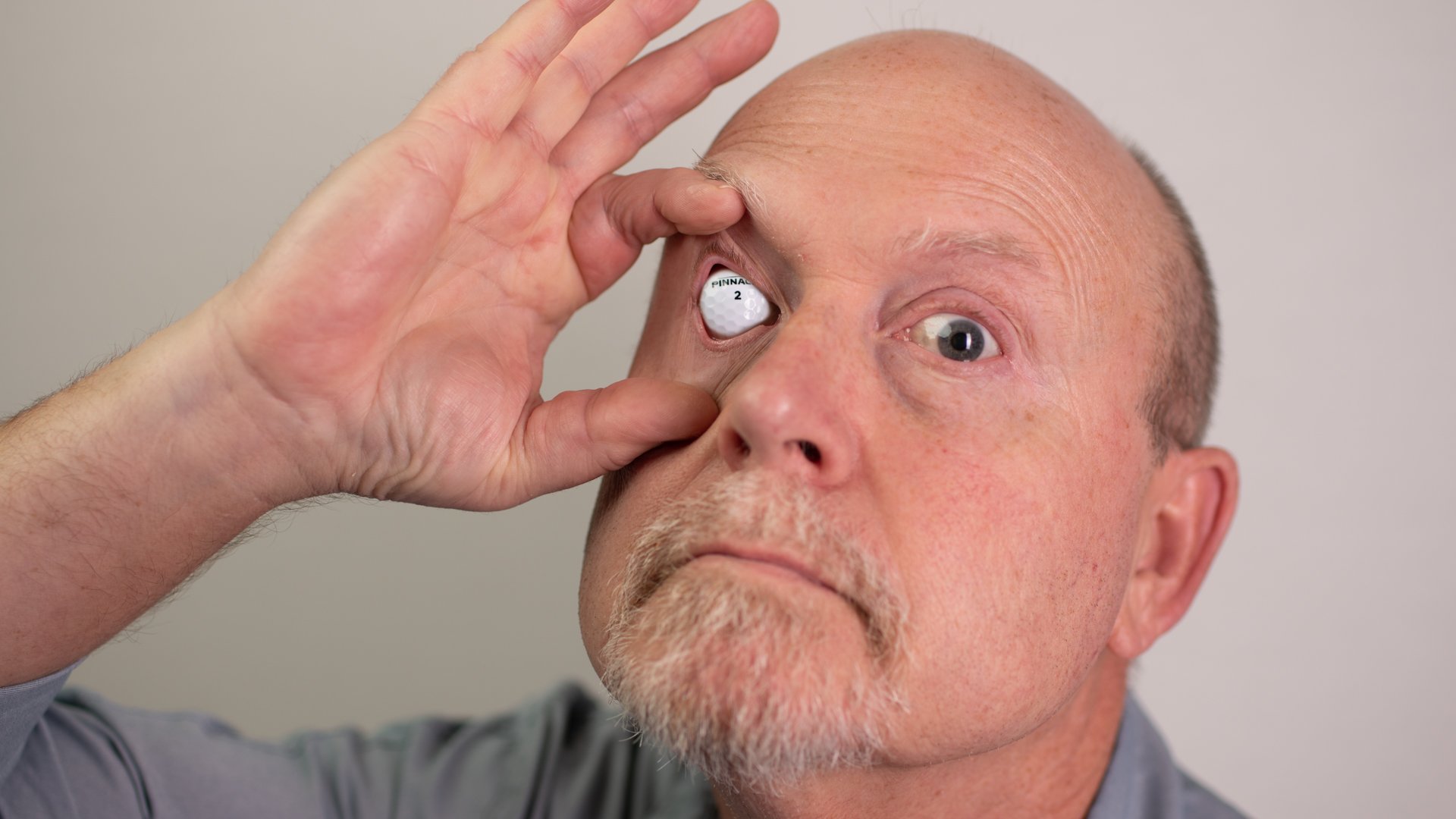
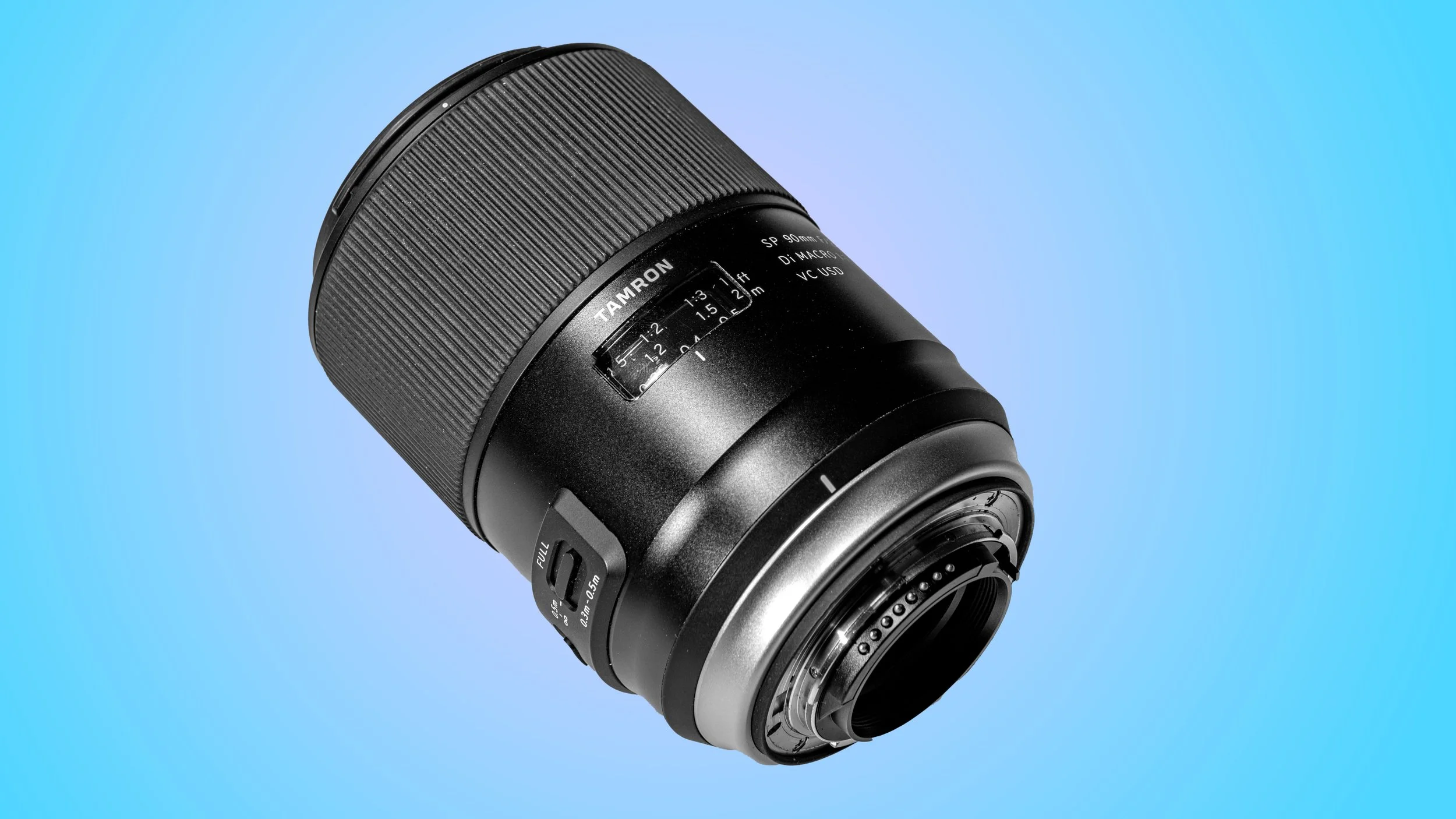
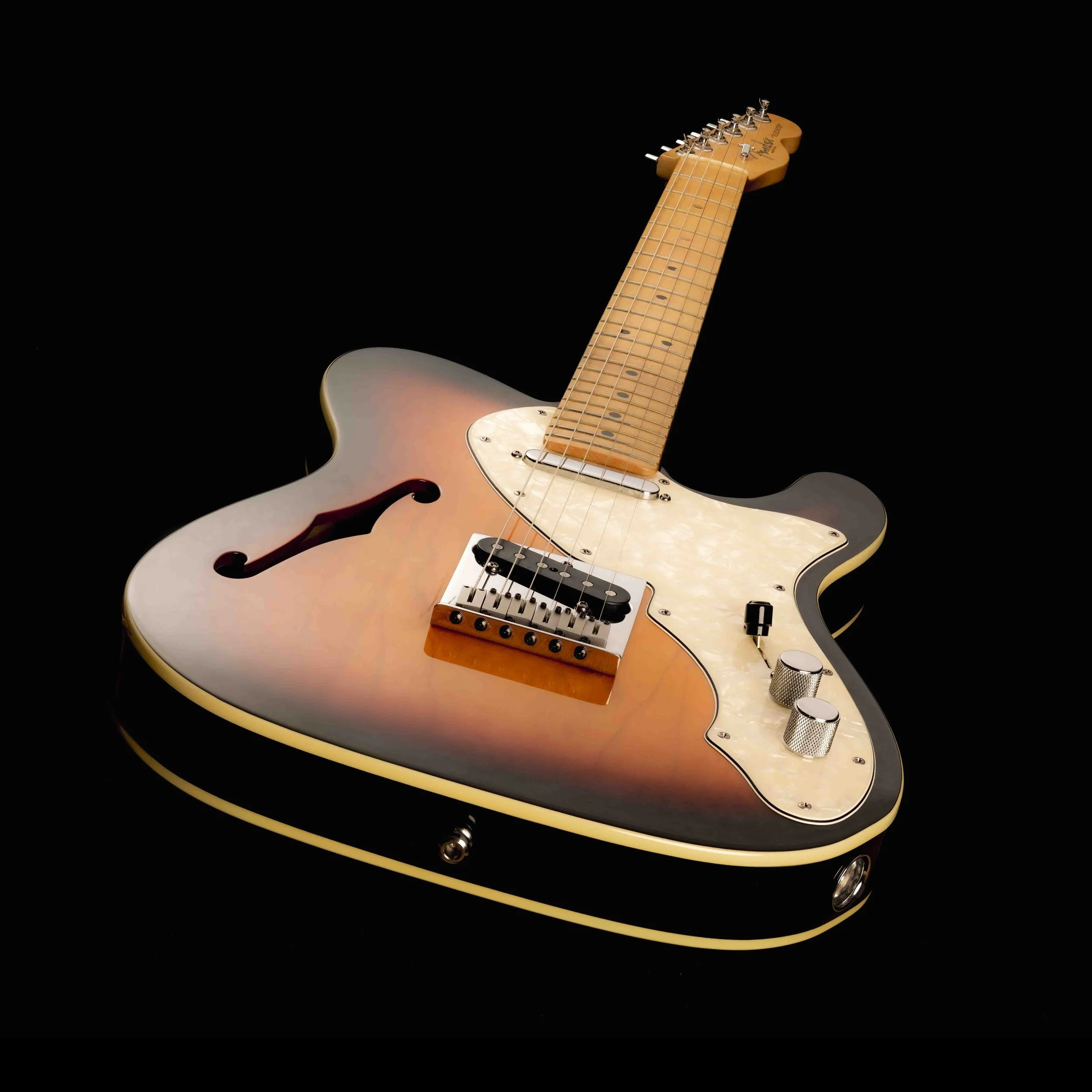
A product photograph


It has been another busy weekend, with a competition to judge and a results video to record and edit, but I loved every moment of it. Working on the “Product Photography” competition with Graham Carey was a clear highlight. He is a thoughtful and fair judge who calls it as he sees it while remaining generous and gentle in his balanced and constructive criticism. My channel and I are most grateful to Graham for his hard work and constant enthusiasm during this process. I should add that I cornered Graham and asked him to do this, but it does not have to happen that way! If you would like to join me as guest judge in an upcoming competition, you are invited to come forward and let me know. If you have been around macro photography for a while, or have experience judging competitions like this, and would like to spend a day or so looking at and talking about macro photographs with me - let me know and I will be in touch.


Congratulations to the winner of this month’s competition, and to everyone who entered. If you want to know who that might be, watch the results video, released earlier today. You can watch it over on YouTube by following this link … https://youtu.be/eBTz2HBWWUY

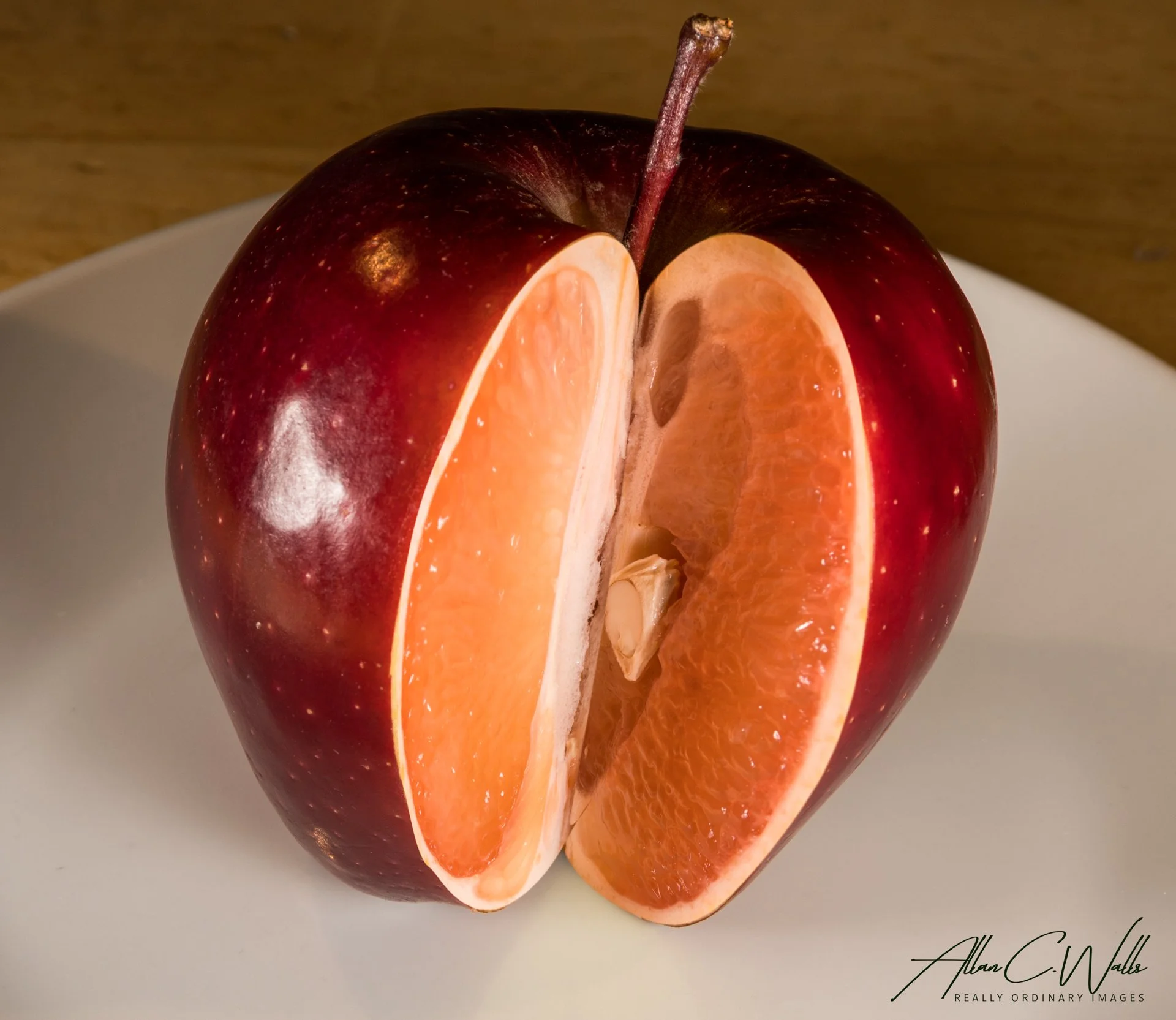
Another product photograph


In retrospect, this topic, product photography, was one of the hardest assignments I have given for this competition. Product photography is a fairly unique discipline for a couple of reasons - firstly, it is absolutely unforgiving  when it comes to accuracy and fidelity in your depiction of the product. Next, it demands that you have mastered the art of telling a story through images alone. Then it requires you to tell that story, without ambiguity or uncertainty, so that the product is the undisputed hero of the tale, and something that the viewer of the image will be drawn to and moved by. Remember that the product photograph exists for one reason - to influence the purchasing decisions of those who see your image. It is probably true that most casual viewers will not notice a slight softening in part of an image, or some noise in the darker parts of the composition. They may not be able to point out that the horizon is tilted this way, or that. But they will notice that there is something not quite right with the image. One doesn’t need to be a photo-critic to feel that something is off in an image, and that feeling is all it takes to leave the potential customer with doubts about the product.

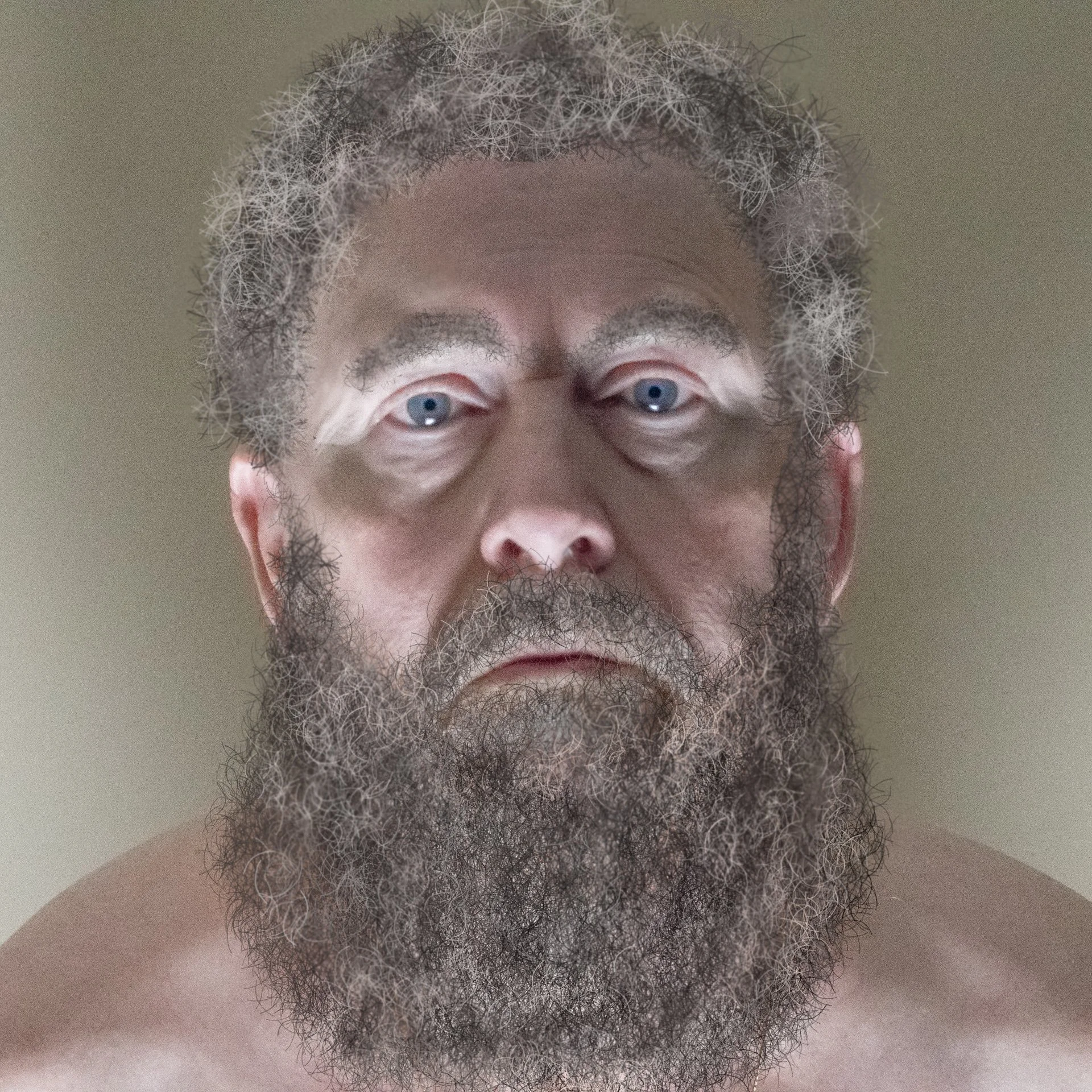
And another


In this most recent competition, the task was to produce an image of a product of your choosing in such a way that viewers of the image would form an emotional connection to the item - they would want to have one. As I looked at the entries it quickly became apparent that I had failed to make this as clear as I should have. There were a number of issues that came up over and over again, some of which were related to technical photographic missteps, but most of which were a result of confusion over the prime directive of the product photograph. So I thought it might be useful to summarize the key points that came out of this exercise and provide some guidance to those who may feel the urge to enter a competition with a similar theme in the future.

So here we go - a checklist for the next product photo competition you want to enter (and win!).

PRODUCT PHOTOGRAPHY CHECKLIST

A Checklist for Non-product Photographers (or how to win a product photography competition)

This is a checklist for “studio” based product photography. It is only a partial list drawn from personal experience and from evaluating the work of students of photography. Some of this also pertains to other disciplines of studio still life photography but most is specific to this kind of work.


When faced with entering a competition like this, think hard about your subject and make sure you can answer all these questions in the affirmative:

1) Is it absolutely crystal clear what my subject is - can an ordinary person look at the object and know what it is?

2) if not, can I tell my viewer what they are looking at in one or two words?

3) can I make this object look desirable?

4) when someone looks at my product image will they have enough information to track down and buy the item?

When you have a promising subject/product lined up, you may proceed …


1) Product Selection -

          a) Select a subject that is, at least, potentially desirable to a broad range of people (not a tube of hemorrhoidal ointment, for example)

          b) Select a subject that can be identified clearly and unambiguously from the photograph you will take (e.g. a camera body with “Sony” and “A9” visible)

          c) Select a subject that is produced in sufficient quantity to justify the expense of an advertising campaign and expensive product photography (avoid unique items unless they are widely accepted as representative of a class of products)

          d) Select a subject that is less demanding to photography (avoid glass and polished metal, favor simple geometry and matt finishes)

2) Product Preparation and Staging

          a) Clean the product, then clean it again. Repeat until it is devoid of fingerprints, dust, or blemishes. Examine under a magnifying glass or microscope and repeat cleaning if needed.

          b) Remove cellophane of packing materials from all surfaces

          c) Use lint-free cotton gloves to clean and stage product

          d) Take product out of its package - packaging may be shown in the image if it is recognizable, unusually attractive or noteworthy, or is symbolic of brand

          e) Labels must be straight, unstained, not peeling, symmetrically positioned - soak, remove, and replace if needed

3) Product Positioning

          a) With rare exception, use a background that is neutral and unlikely to compete with the product for viewer interest

          b) If the brand or model number of the item are visible on the product, position the subject such that this can be clearly seen

          c) Position the product so that all of it will be visible in the frame

          d) If the product is in a bottle and the bottle is translucent, position it in such a way that it can be transilluminated to reveal contents

          e) If the product will be accompanied but a prop, make sure the product is positioned dominantly and the prop is positioned realistically in relation to the product. The prop should not compete with the product

          f) Backgrounds may be contextual but must never draw attention away from the product

4) The Photograph

          a) Use lowest ISO available (usually base-native - 80 to 200 for most sensors) and avoid extended ISO settings

          b) You control the light - use the highest quality continuous or flash lighting that you can afford, avoiding mixed sources

          c) Use the amount of light needed to keep the ISO at base and shutter speed fast enough to avoid any motion artifact

          d) Always use a color/gray card to ensure color accuracy in post-production - do not guess at color

          e) Set up lighting carefully and deliberately, using position, distance and diffusion to avoid specular highlights, unwanted shadows

           f) Build up lighting one source at a time, using test frames to ensure desired effect

          g) Focus accurately - do not hesitate to use focus stacking or tilt/shift lens manipulation if required

          h) Use only the best prime lens you have, at the correct focal length for the desired effect

          i) Inspect and clean your sensor if needed

          j) Use only your sturdiest camera stand or tripod

          k) Avoid crowding the frame and leave room for adding script in post

          l) Trust your histogram and shoot for the center of the curve - reject images with clipping

          m) When focus stacking, use the correct method based on subject size (lens helicoid for larger subjects etc.)

          n) Always take a few frames of the background without the subject, but with the lighting precisely as it will be for the final image

          o) Take more shots than you think you will need

5) Post Production

          a) Edit for the subject first

          b) If script is required to clarify brand or model information, use the fewest words possible and a font that is product-suitable and clear

          c) Position script carefully, avoiding peripheral or poorly balanced asymmetrical placement

          d) Avoid adding shading blocks under script  to increase contrast - shoot with script placement in mind

          e) Use caution editing colors - use a calibrated screen and triple check the color accuracy of final image

          f) Crop with care, but do not avoid cropping to balance final image if needed

          g) Avoid compositing unless you are very good at it


That should be enough to go on. We could probably expand this list indefinitely, but this should cover most of the important stuff.


An important note to October’s contestants

I am presenting this list of tips after judging the photo competition for October, 2025. I am not doing it to be critical of any of this months entries and hope you will not take it that way. On the contrary, I am doing because I recognize how hard you all must have worked to produce these remarkable entries. If I am being critical of anything it is of my poor work in helping you prepare for this difficult challenge. I feel like I could have done much more to give you the tools required to rise to this occasion. I personally love product photography and the unusually rigorous challenges it offers. I also think it is some of the best training for all forms of closeup imaging and well worth the investment to learn. This is my attempt to make it a little easier for you to learn these skills and experience the same joy and excitement that I find in this unique and demanding corner of photography. If you want help, let me know and I will do what I can.

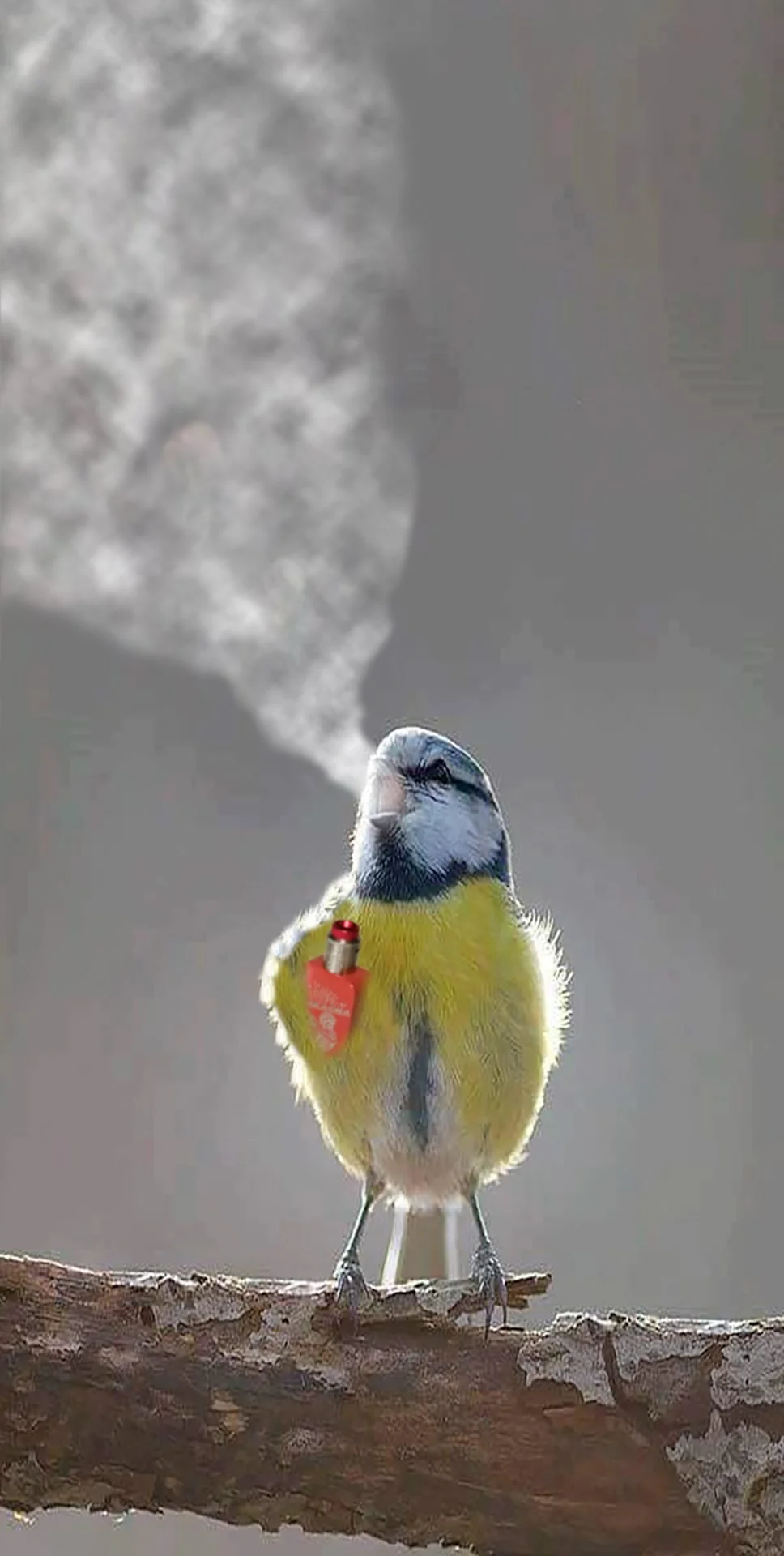
One last product shot


So with that done we should talk about the week to come.

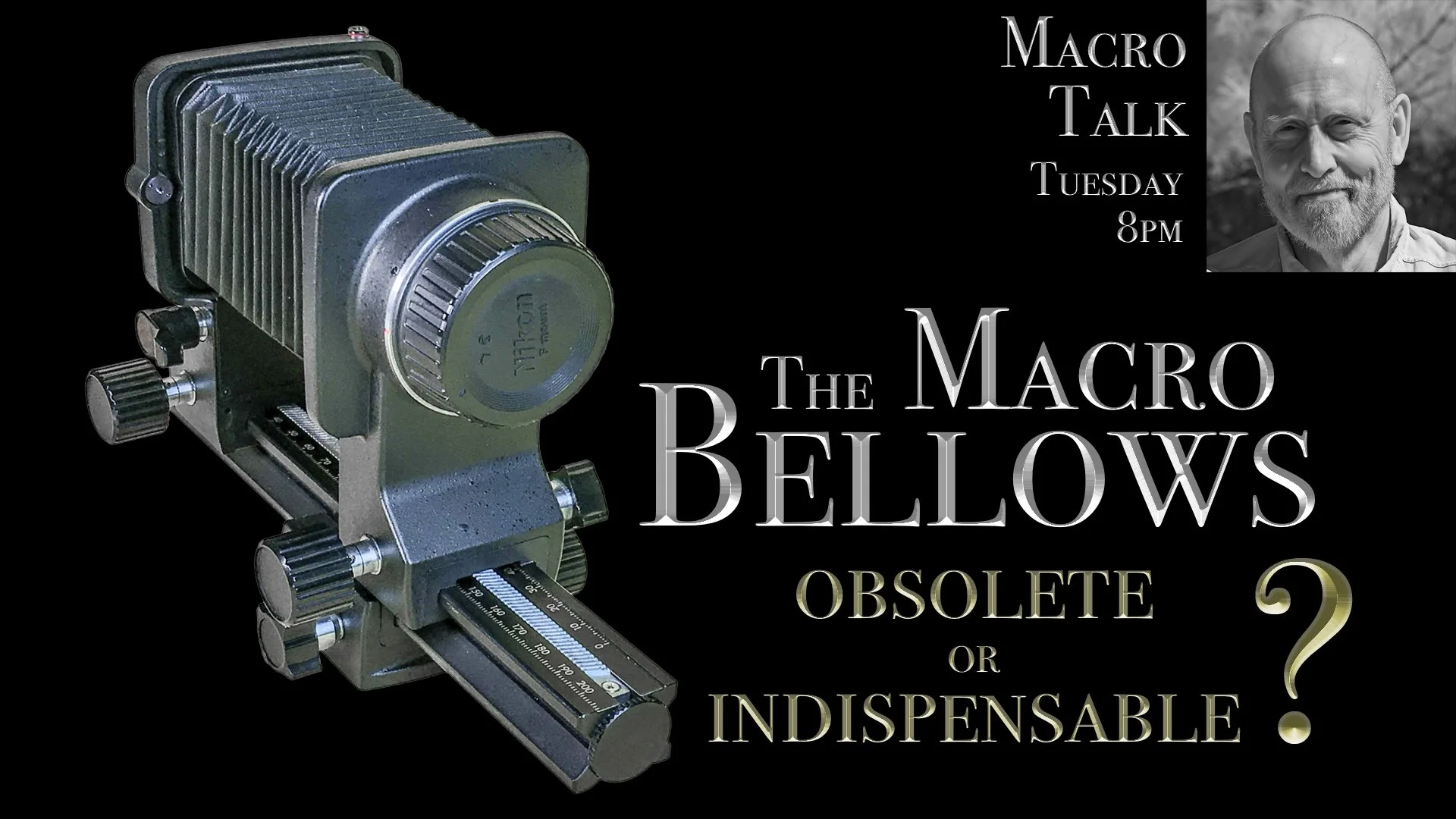
My livestreams this week are not following a particular theme - they are subjects that have come up in conversation and strike me as interesting enough to warrant a closer look. On Tuesday, for example, I am going to revisit the bellows and come at it from a slightly different angle. This will be useful, I hope, for beginners and seasoned experts alike as I will start out by explaining when and why bellows is the best choice for extension. I will compare tube extension with bellows work and talk about the criteria I use to decide on which to use. Then I will talk about the different bellows available and how they compare in terms or features, durability, and cost. I will also discuss some of the less typical ways the bellows are used in modern photography, including rear-bellows focus and infinity focus calibration. Lastly I plan to demonstrate how to set up a bellows for internal lens mounting and show my setup for rear-bellows focus. I think it should be interesting and a lot of fun. You can join the livestream using this link - https://youtube.com/live/TgSTcPVXrB4?feature=share


On Thursday in Macro Talk Too, I am planning to do a 2025 update on the global insect market. With winter right around the corner, this is the time of year that many of us start to think about winter projects. Especially those of us who now live in places that have real winters. I have been looking around the various vendors and markets around the world and have seen some availability and pricing trends that I think are worth discussing. I will also give some updated recommendations on the vendors that I think will be most responsive to the insect photographer’s needs this winter. I will make one caveat concerning this discussion - I may  have to delay it a little while if I do not get all the information that I am still waiting on. I don’t think I will need to postpone, but just wanted to alert you to the possibility. Either way, your link to the discussion is here … https://youtube.com/live/EpytPEaVlWQ?feature=share

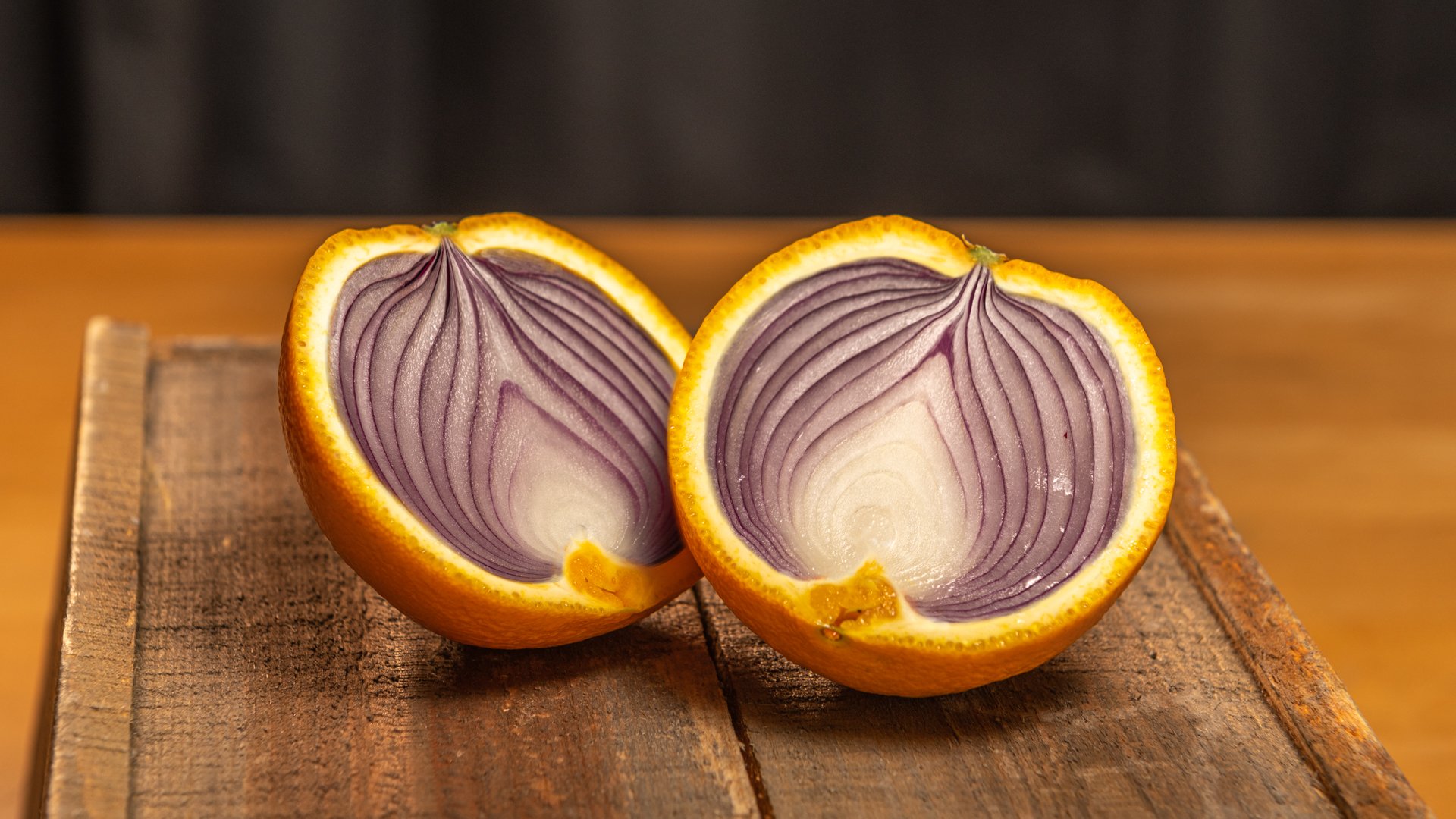
Do you know what this photograph is of?


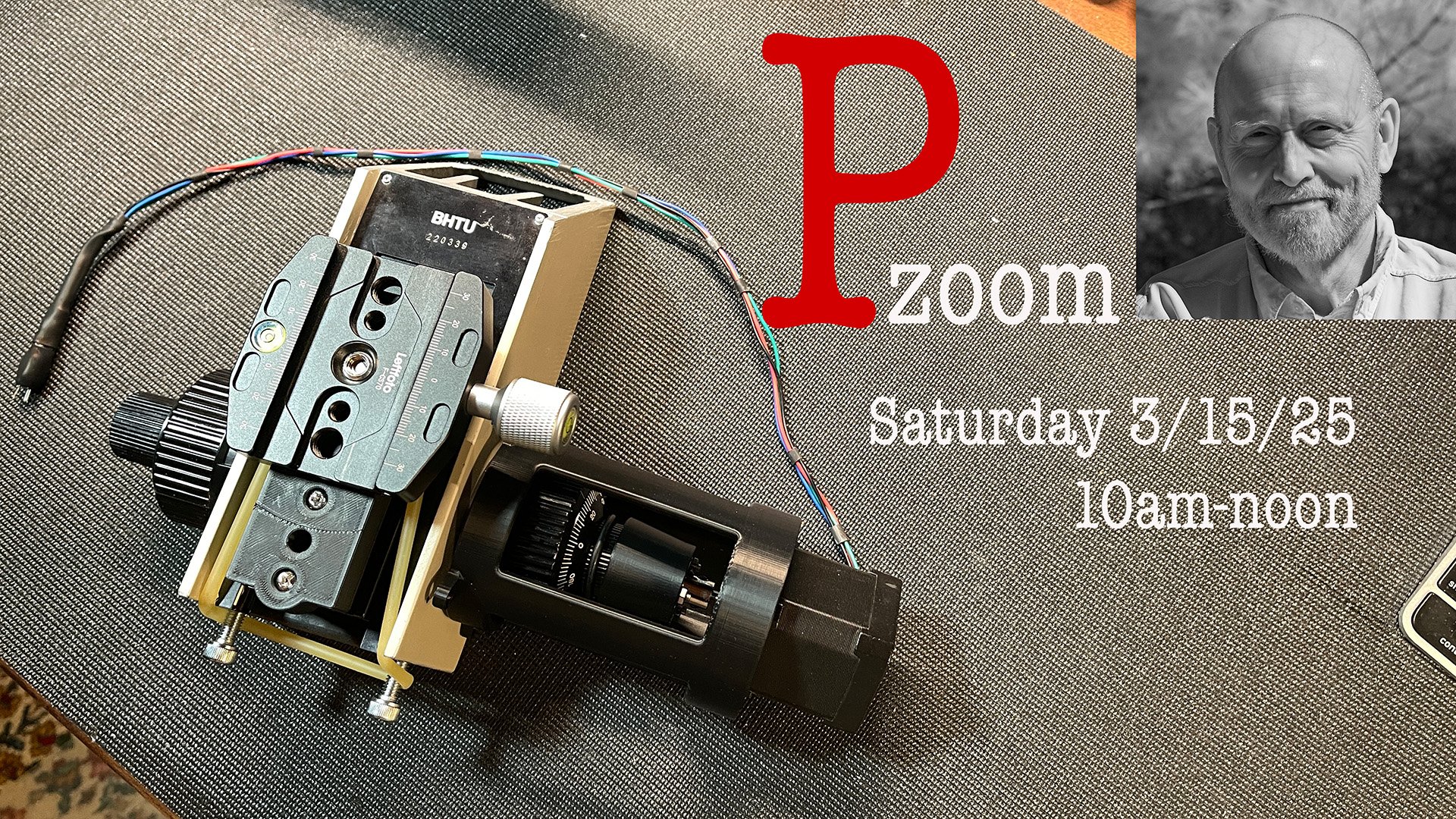
Saturday sees our first Pzoom of November, from 10AM until noon, and I already have a couple of items lined up. If you need time for an update or introduction, let me know through Patreon and I will sure to reserve your time. More information about the upcoming Pzoom can be found over on the Patreon website by visiting https://www,patreon.com/allanwallsphotography (which is also the place to go for more information on how to become part of our super-cool macro group).

An unusually gorgeous crystal


Don’t forget that the Crystal Art zoom gathering takes place next Friday, November 14th, 2025, at 2PM - I will post the invitation in next week’s blog post. The group is all about making and photographing incredible birefringent crystals and is free for anyone interested in attending. It is a lot of fun well worth a visit (IMHO)!

playing around with the bellows

Hope to see you at one of this week’s events!

Macro Jeopardy is HERE!

An exciting week of photography and foolishness starts today.

one reason i don’t live in the mekong delta

Some real treats to look forward to in the coming 6 day! Starting with Macro Talk on Tuesday at 8PM where the discussion is going to be all about enlarger lenses.

These seem to be among the least well understood lenses in our regular arsenal so I think spending a little time talking about the many misunderstandings surrounding these little treasures might be time well spent. The things I want to clear up include:

  • What is an enlarger lens

  • Why do we use them in Macro,

  • Reverse, Extend, or both?

  • The limits

  • Aperture, focal length & diffraction

  • Stacking enlarger lenses - Whaaat!?

  • Setups that work & setups that don’t

  • When to reach for an objective

This isn’t everything, but these are the high points. I may be able to include a little demo using some of the enlarger lenses I have been evaluating lately. Come to this livestream and I promise you will leave with a solid working understanding of how to get the very most out of these treasured lenses. Here is a link to the livestream, at 8PM Tuesday!

https://youtube.com/live/RJJsWfgXW4E?feature=share

Four stripped focus blocks ready for stripping, PaiNting and reassembly


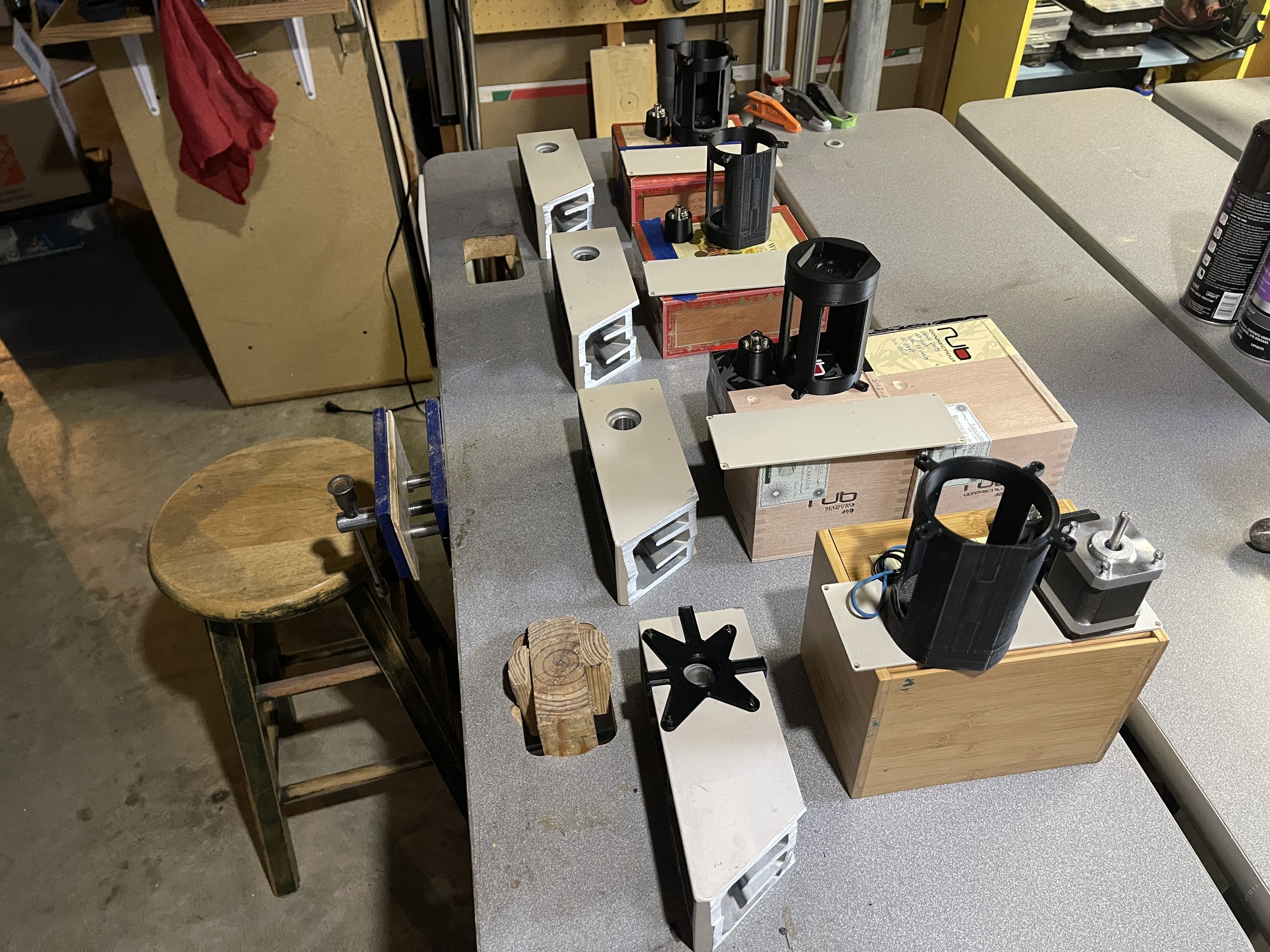
I spent the entire weekend cleaning microscope parts, dismantling focus blocks, 3D printing parts, and inventing new tools for the workshop. It was a lot of fun but I woke up exhausted and ready for a break on Monday (today) If I have time I want to show you around the workshop, so that you can see what all goes on in the studio when I am in full-conveyor belt mode. Though it might need to wait for the Pzoom, as I have a special treat for you on Thursday! Macro Talk Too this week features the very first installment of the new MACRO JEOPARDY - the world’s most exciting internet macro photography game show (strictly my own, heavily biased opinion)!

As a teaser, here is a screen shot of the game board for this real time contest of wits! I have spent several hours putting together what I think are an excellent selection of macro-related questions.

If it is a success I will see if there is a way for us to do this with real contestants, using zoom - I am thinking about finding a sponsor or two and putting up some nice prizes. I might even draw the names of contestants from the competition entries. This week is just a trial balloon to see if folks are interested in having a little cerebral fun at the end of a long week. If you want to join in the fun, your link too the stream is right here -

https://youtube.com/live/A55-hCkZhrw?feature=share


Of course, it is not the end of my week as there are a couple of interesting events lined up for Saturday - starting air 10AM with a 2-hour Pzoom - a face to face Zoom meeting with  my Patreon Supporters. As always we will have a lot to talk about, including a special segment on how to dismantle, inspect, clean and rebuild a modern microscope. The rest of our time will focus on viewer updates, Q&A, introductions, and a lot of macro-equipment chit chat. Always great fun and an awesome opportunity for us to learn a bit more from one another.


Right after the Pzoom we have this month’s Tangent Show with Larry and me - talking about Fusion 360, modeling, and 3D printing. I am hoping to get some help with a really complicated job that is making me think I may have bitten off more than I can chew. I am making a camera, a real digital camera, and it is proving a lot more difficult that I thought it would be. So, depending on what Larry has lined up for us, I may be trying to get a little nudge in the right direction on this project. This is all happening at 12:30pm this Saturday, April 26th, with the recording released on YouTube early next week.

My sweatshop - only without the sweating


I did come up with a very handy gadget for making sure my motor drive assemblies will fit on a microscope focus block after all the holes are drilled - a ver irritating problem when they do not.

It looks deceptively simple, but these things are designed to clip onto a stripped focus block and stay there until all four holes have been marked. This works extremely well and saves a tremendous amount of time.

Here is a drawing of the gadget, as yet unnamed, and a picture of it doing its thing on a BH2 Olympus focus block being readied for a coat of paint.


A couple of you have asked to see my new bandsaw - well here it is!

It is not nearly as easy to use as it looks. In fact, by the time I have cleaned up all the cut lines, I don’t think it will have saved me much time, if any. The saw was not too expensive and it will definitely be put to good use in the future.

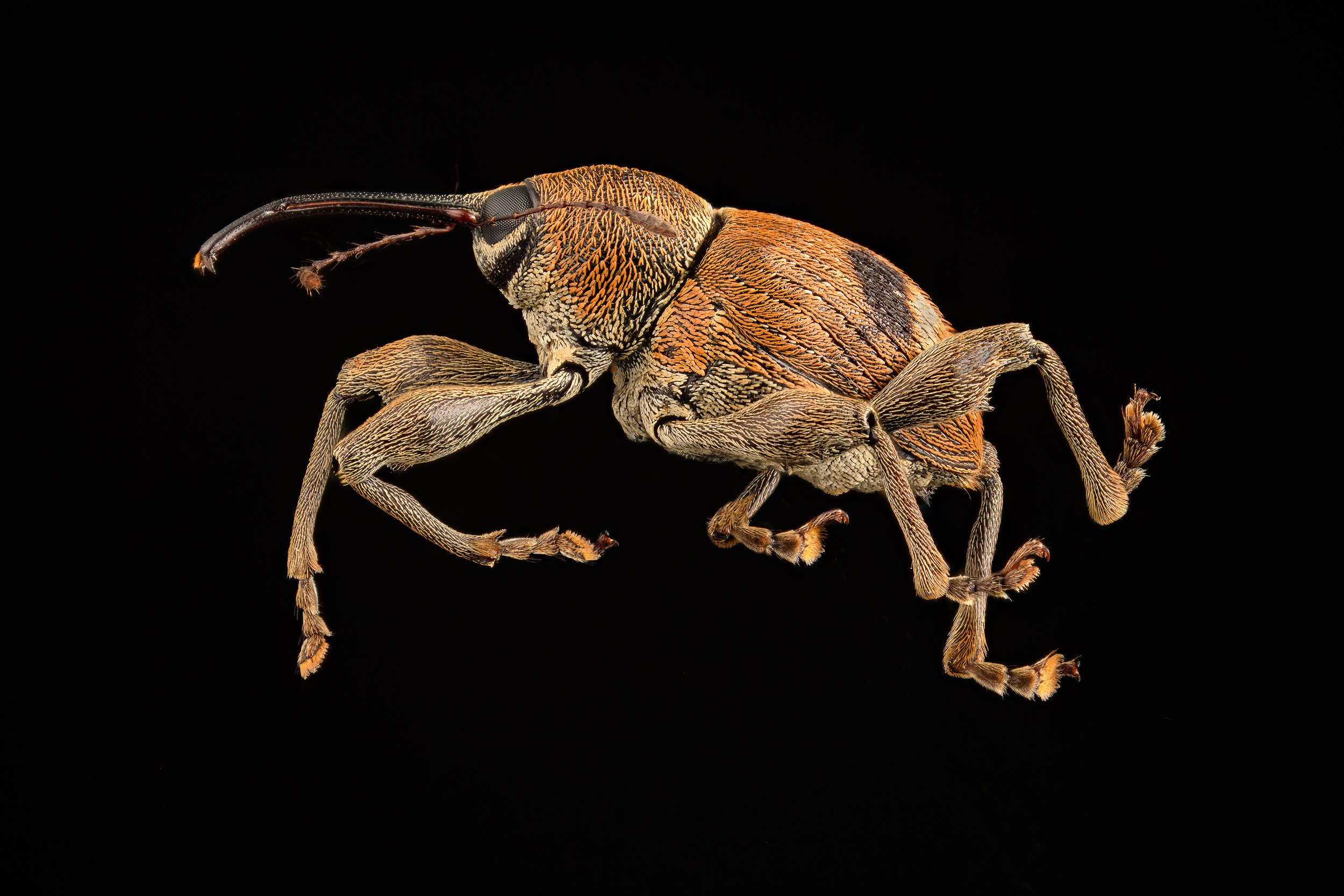
A Happy looking weevil

I have not been taking nearly enough pictures of late, but hope to turn that around soon, as the weather continues to improve - stay tuned!

another partially braided acetanilide and ascorbic acid crystal complex

Hope you can make it to the Jeopardy on Thursday! It is going to be a hoot!

Later, Allan

Short Focus - A Primer

All my clocks are broken. Or so I thought on Sunday morning, for maybe the 120th time in my life. Of course they are not broken and the sun is still above the horizon at 5:30 PM on this first Sunday evening of “normal” time. Another weekend has flashed past during which I developed a revolting sinus infection (my first) and built a bunch of photography gadgets. I also spent a little time thinking hard about whether or not I should wade into the murky waters of small-scale manufacture and actually try to make a little money selling some of this stuff.

A focus block conversion

There are pros and cons, of course. On the plus side, I really enjoy the process of designing, drawing, prototyping, and finishing all these projects. I love testing them and using them, too. I like getting feedback from my friends and working to improve on designs and building approaches. I even enjoy sourcing the best low-cost parts for the projects. Now, a big part of this is that I work on these projects to relax and test myself - the only schedule is the one in my head and I seldom allow my “hobby” to get in the way of my work. But what happens when someone is paying real money for one of these things - how relaxing will the work be then? And then there is the whole money thing. I am not very good about asking people for money because it makes me feel uncomfortable, as does receiving it when I do work up the courage to ask. Becoming a maker and seller of these gadgets would mean I would have to do this a lot (hopefully), and that sounds a little scary.

The conversion motorized


Neither the focus block stacking device nor the cross polarizer platform were cheap to make. That is because neither was close to finished until I had drawn, printed and assembled at least half a dozen prototypes - a process taking several weeks and a bunch of parts. But even accounting for my time, they also weren’t that terribly expensive to make either. So, at the end of the day, I am not exactly sure what they are worth, and I absolutely need to know that before I will sell one. I try not to talk about this channel’s finances - it is too embarrassing - but an infusion of profit from something like this would  be most useful and very welcome. Then there is the question of what I should actually try to sell - a complete, ready to use gadget, fully assembled and ready to use? Or a kit, complete with plans and instructions? Or some other hybrid arrangement? I just don’t know.

One simple eye of a velvet ant at 20X - no reason, just like it

So I am going to ask you what you think and I would be most grateful for any feedback you can offer. It should go without saying, but this is just me asking you what you think. It is not a solicitation and I will record your feedback without identifying information. If you feel so inclined, please answer a couple of simple questions for me - you can do so in the comment section below this post, or you can contact me in any other way that is convenient. You are also welcome to answer only the parts you want to. Here we go:

  1. Would you be interested in buying a fully ready to use cross polarizing birefringent crystal viewer and imaging platform?

  2. How much would you consider a fair price to get one?

  3. Would you be interested in scoring a microscope focusing attachment to use with your stackShot or WeMacro controller?

  4. How much would the whole assembly, not counting a microscope, be worth to you (frame, fine focus interface, Motor, cables)?

  5. Would you be interested in getting a free standing, ready to use fine focus device including a microscope focus block and the drive assembly (for use with whatever controller you already have)?

  6. How much would that be worth to you?

  7. Is there anything else that I have invented/built in the last few years that you would like to have a chance to buy?

  8. Any other words of wisdom or encouragement?

the testing platform


Thanks for doing this - I will let you know what the bottom line is in a few days. Now here is a picture of a bridge. No reason.


So what are we up to this week?


On Tuesday, in Macro Talk, I am going to tell you everything you need to know about the technique of short focusing in high magnification macro photography. It is surprisingly straight forward, but can add a very exciting dimension to your use of objectives as camera lenses. I will cover what it is for, how to set up the equipment, the potential problems, and the gear you will need. Then I will tell you exactly how to evaluate and relay lenses that you think may work for short focus and actually walk through the process using one of Susan Seaford’s telephoto Nikon lenses. Fun! The link is here… https://youtube.com/live/GAsu-jhdp-s?feature=share


On Thursday we are going to take one more look at the two macro-gadgets I have been working on for the last month and I will complete the circle by giving you step-by-step instructions on how to take full advantage of the two 3D print files that I released earlier today. Literally everything you need to know to build and use both devices for your own rig. Even if you have no interest in building either of them, there will still be a ton of interesting stuff to talk about. Don’t miss this one! The link… https://youtube.com/live/7WhjIWPh8fE?feature=share


Saturday is Pzoom - a private face to face meeting with my awesome Patreon supporters, where they get to ask questions, lodge complaints, hurl obscenities, and just have a good old time with their host - me! I will have a few surprises for the group and we are going to have a very good time - promise! The invitation is posted over on my Patreon page at www.patreon.com/allanwallsphotography


If you missed the last AfterStack, fear not, as it is now available by following this YouTube link to the recording!


A busy week and a lot to prepare for, so I had better get my skates on! Hope to see you soon! All the best!

Allan

Shifting Perspectives on Epi-illumination

Greetings all!

The title of today’s post is about as accurate as I could get but the post itself is going to be very brief. It does contain a couple of important announcements that you need to hear - so I will get right to the point.

I have been informed that the competition photo-naming convention that I announced a couple of weeks ago has some formatting issues, so I am going to change the instructions accordingly. This will take effect immediately, but I will not disqualify mis-named images until the March competition. The format for naming your entry (and the filename for the image - they need to be the same) is as follows…

_exact.image.title_your first name.your last name.image file type

Every entry must have the same filename and image title and both must be in exactly the same format. There should be NO spaces, so words are to be separated using a period. The convention I announced earlier used “quotation marks” - these are problematic for some computers, as are spaces, so I replacing the quotation marks with underscores (_) and the spaces with periods (.). Using this convention a typical entry would look like this …

_green.weevil.foot_allan.walls.jpg
I hope that is completely clear but if you have any questions, please ask. I really do not want to have to disqualify any images.


We had an excellent Tangent livestream this last weekend, with lots of useful information for anyone using 3D modeling or printing. The session was recorded and the recording is now posted on YouTube - this link will take you right to the recording …


This coming weekend we have Episode 17 of AfterStack and this week we will take a look at the Photoshop focus stacking utility. This can be a very handy tool but it pays to know its limitations and how to use it. We will also be discussing any images you have been having trouble with, and because of that, the next announcement is also important …


I have set up a Google Drive Folder named “AfterStack” that can only be accessed by following this link -

https://drive.google.com/drive/folders/1XA7tv9O2SW0TGRjiIIRBzMRMAu-ZAkKe?usp=sharing

Please save this link and use it for sending images that you would like to have discussed in AfterStack.


Don’t forget AfterStack 17 starts air 10AM this Saturday - Here is your link to the meeting -

Allan Walls is inviting you to a scheduled Zoom meeting.

Topic: AfterStack 17

Time: Feb 22, 2025 10:00 AM Central Time (US and Canada)

Join Zoom Meeting

https://us02web.zoom.us/j/6916802815?pwd=TS9tZi9ZL1NXeVUvOUF4eTg5YjdlZz09&omn=83179811857

Meeting ID: 691 680 2815

Passcode: 678122


Last Saturday’s Pzoom recording is available to Patreon Supporters and can be found on my Patreon page (https://www.patreon.com/allanwallsphotography) and while I am thinking about it, I have also set up a Pzoom Google Drive Folder and the link to that folder is also over on Patreon.


Getting to this week’s planned Macro Talk and Macro Talk Too discussions, we are going to delve into a couple of technical topics that will be valuable to anyone interested in expanding their macro skill set or trying something new. In our first livestream we are going to take a look at epi-illumination using a very inexpensive coaxial lighting setup. I will walk through the equipment and demonstrate how the rig should be assembled. I will walk thought the steps for setting up a photograph and make some suggestions for suitable subjects and discuss some of the technical limitations of this technique. There will be plenty of time to answer questions. https://youtube.com/live/NNZTNaj0sVQ?feature=share


On Thursday we will change gears and discuss a technique that is uncommonly applied today, but one that is well worth understanding. Using the tilt, shift, and swing capabilities of some lenses, adapters and bellows to manipulate the focal plane to alter perspective in close-up and macro photography. We will accomplish this while taking a look at one of the most complicated bellows devices ever sold - the Kenlock bellows. I am sure that by the end of this hour you will clearly understand the  title of this livestream! https://youtube.com/live/0J4nqSb1CCc?feature=share


With so much technical discussion in the coming days, I need to get to work on my preparations. I look forward to seeing you at one or more of these events and encourage you top bring any questions you may have.

Resolution

Resolution…

I am not talking about the empty promises made in haste at the New Year’s Eve party only to be unceremoniously discarded like the last half carton of egg nog, the purchase of which had seemed like such a good idea the week before Christmas. The resolution that I want to talk about this week is the ability for an optical system to distinguish two points that are in close proximity as separate entities on our camera’s sensor. Assuming, of course, that the number and size of photo- sites on the sensor, or the light sensitive cells in our retinas, are capable of resolving detail to the same or a higher degree, the limiting factor becomes the numeric aperture of our objective  lens. The relationship between resolution and the numeric aperture of a system can be loosely defined by the formula:

Resolution =(approximately) the wavelength of light/ 2 x NA

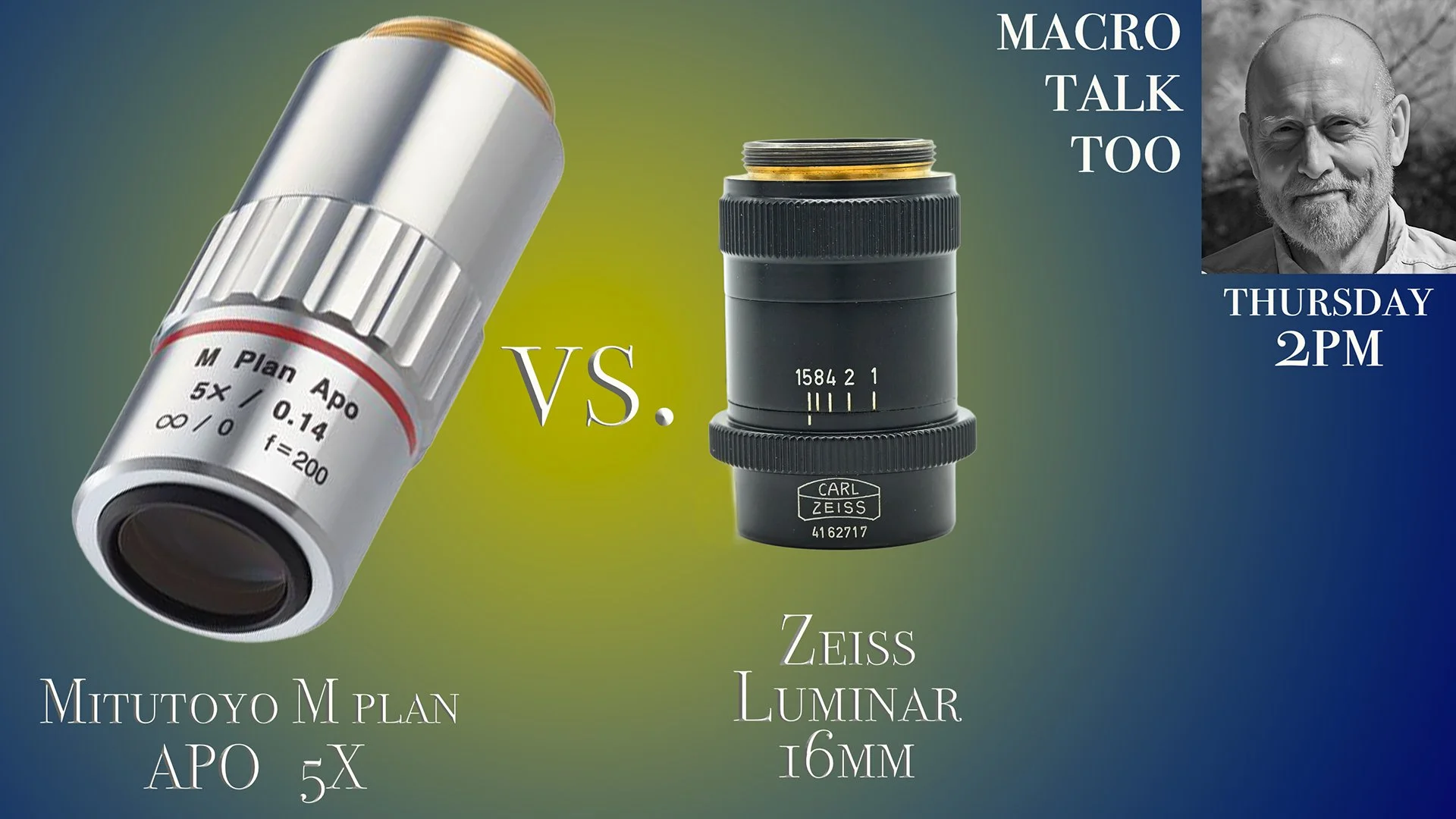
This is just a helpful approximation, but good enough to make it clear that the higher the NA of our objective, the smaller the separation of points and the more resolving power in the system. We typically use objectives that prioritize full spectrum color correction and long working distances, as these characteristics of a lens give us much less color fringing while providing a lot of room  for illuminating our subject. A good example of this is the 5X Mitutoyo M Plan apochromatic objective. This lens has a numerical aperture of only 0.14 but the low resolving power (2um) is an acceptable trade-off for the huge working distance of 34mm.

Consider now the resolution of an objective like the Olympus UPLX APO, which has a numerical aperture of 0.8 (at 20X) - it is also  an apochromat, but can resolve to 0.42um - five times the resolution of the Mitutoyo (and more than twice the resolution of the Mitutoyo 20X SL WD which only has an NA of 0.28). It seems, therefore, that we are limited to using only lower NA objectives because the  corresponding tiny working distances make it all but impossible to get enough light onto our subject for photography to be possible.

At first blush, this appears to present us with a Hobson’s Choice - or no real choice at all. We can take it or leave it. We choose a high NA objective or a well lit subject, but not both. However, there is another option and that is going to be the subject of Thursday’s livestream. I am going to show you a practical and affordable alternative method for using high NA objectives  while also illuminating the subject for photography. This will not be a novel concept to everyone, but even for those of you who already know the answer to this perplexing puzzle, it may surprise you to discover just how accessible super-high-resolution photomicrography  can be, with a small investment and most of the same equipment you already have. Tune in to Macro Talk Too this Thursday at 2PM to get everything you need to dive into high-resolution photography! https://youtube.com/live/DHEicfFzmgE?feature=share

Let’s now work backwards to Tuesday’s Macro Talk, our first livestream this week, at 8PM on YouTube. We are going to have a Competition Results Special, in which I will discuss the entries to last month’s contest and announce the winners. I have decided to do this because my plans for judging this competition and recording the process for release in a video fell through at the last minute. My guest judge was called away on urgent business and was unable to complete the judging and recording. So I am going to go it alone this month and if I am doing that, I might as well do it live, as these livestreams are always a lot of fun to do. There were only about 35 entries this month (mechanisms was the theme) so I should have just enough time to go through every entry. Your link to the results livestream is right here - https://youtube.com/live/RQnBEEOL3CA?feature=share

This Saturday, at 10AM, we have another AfterStack - this is Episode 16 - and Bud Perrott will be back to lead this discussion. If you have an image you would like to have discussed be sure to send it to Bud or I this week. I believe Bud has a topic lined up and as soon as I find out what it is I will announce it in a livestream. This post-processing round table discussion is free of charge and open to anyone interested in attending. But you will need an invitation to get in - here it is -

Topic: AfterStack 16 Time: Feb 8, 2025 10:00 AM Central Time (US and Canada)

https://us02web.zoom.us/j/6916802815?pwd=TS9tZi9ZL1NXeVUvOUF4eTg5YjdlZz09&omn=84267941870

Meeting ID: 691 680 2815

Passcode: 678122

At the end of last week I had the distinct pleasure of meeting Zamir Pena, the inventor of the AK Diffuser and owner of the business by the same name. He is a delightful young man and our conversation covered quite a bit of ground. I decided to include a summary of my review of the AK diffuser with the interview, which will be released very soon. For anyone thinking about adding the AK Diffuser to their field macro kit, something I strongly suggest you do, Zamir has very kindly arranged to offer a discount for my viewers. This information will also be included in the video, but you can also take advantage of it now by going to:

www.AKdiffuser.com and entering the code “Allan Walls” before the end of February to get a 5% discount.

By the way, I was offered an affiliate relationship with the AKDiffuser company. I decided that this may be perceived to introduce a potential bias that could be influencing my review, so I politely declined the offer. I will not make a penny from any sales resulting from this or any future reviews or recommendations.

Finally, a word about our growing Macro Competition…

IMPORTANT REMINDER

The naming of your image is important. Failure to adhere to the requested naming convention complicates the judging process, can significantly add to the judge’s workload, and may result in errors. The required naming convention in this competition is as follows:

"TITLE” FIRST NAME.LAST NAME.FILETYPE

This is an example of the correct naming of entries for this competition -       

“Compound Eye” Allan.Walls.jpg       

The TITLE must match the name of the image used when entering the image and should be in quotation marks. Your first and last names should be separated by a full stop (period). We have not enforced this convention, but with new guest judges every month, we have to eliminate confusion about image titles and photographer’s name. So, starting with this month’s competition, failure to comply with the naming convention will disqualify the offending image. This rule will not affect entries submitted BEFORE 10AM on Sunday February 2, 2025


That is all I have for you this week and I look forward to seeing you at one of the week’s events!

Allan

One Cup of Coffee...

… can totally ruin your week, if it lands in just the wrong place. More about this later.

I hope each and every one of you had a delightful weekend. It was lovely in central Illinois, but hopefully it was not the last lovely weekend of the year. Picnic on the 7th of September! I was very busy, as usual, but did take an hour  or two to go and explore the local botanical gardens, the Luthy Gardens, named most likely for a famous Peorian named “Gardens”. It was not the most expansive garden that I have spent time it, but it is beautifully kept and the layout has been planned with great care. I spoke briefly with the groundskeeper, while she was ejecting me from the premises, as it happened - but that was because it was quitting time and   yours truly was holding up the patient employee’s departure.

It was a short visit and flew by fast, and as I being escorted off city property, I was reminded of the cardinal lesson that I teach all my field macro students - you cannot do your best work without slowing down - slowing way down. Running to get to the park, arriving shortly before closing, and trying to see everything in the time I had there, these all conspired with the dozen things I had on my mind to make slowing down virtually impossible. And unfortunately, my pictures suffered as a result. Why is that, and what does a “distracted” photograph look like? Well I would show you, but that is the whole point. When I become rushed and distracted I don’t see the shots, so I can’t capture them. Simple as that.


This is not something I am conscious of most of the time, it is something I become aware of as I look through my shots from the day. Interestingly, there are usually more of them than there would have been from a successful trip. They also lack imagination. They are perfectly acceptable from a technical standpoint (or some of them are!), but they tend to be clinical, ordinary, and unimaginative. It is not unusual for me to see the shot I should have taken, when it is too late to do anything about it.


If you are new to closeup photography in the field you may be wondering what the take-home message is from this observation - should I have stayed home and found something constructive to do? Gone somewhere else to take my pictures? No - I did exactly what I needed to do - I went to the place I wanted to visit and did the best I could with the tools I had on hand. Yes - it would almost certainly have been a more fruitful trip if I could have slowly myself down, or planned to go earlier in the day, but that is not the point I want to make. Macro photography is not about the pictures. Good pictures are a welcome bonus but they are not the prize . Getting out of the house for little while on a stunning Sunday afternoon, that is the prize. This is important, because only when I am truly engaged with the macro photography process do my overdue projects, unpaid bills, and 15,000 unread emails begin to fade into the background hum of the city outside the fences of the gardens.  And as these matters are temporarily set aside, space opens up in the parts of my mind that have the capacity to see and appreciate beauty. When the everyday world around me recedes far enough to seem no longer relevant, when I am moving slowly and actively soaking up all that the day has to offer, when the last thing on my mind is getting a good photograph, that is when I can see the shots. They come to me, I don’t go to them. I just have to be ready to see them and get out of my own way while I take the picture.

I have heard people refer to this as a “state of flow”, which sounds reasonable enough. I think of to as a kind of meditation, but don’t know if this is accurate - I certainly lack the discipline to  sit in silence to contemplate my breath for more than 30 seconds. But I can be out aimlessly strolling through nature, with no concept of time, for an entire day. It there is something magical in this weird hobby of ours, it is here, in the process that it is to be found. And I hope that you do.


And what does that have to do with this week’s livestreams? Well, absolutely nothing, as it happens - it was just on my mind and I wanted to tell you about it.

So, what am I going to be talking about this week? As of midnight last night I was planning on talking to you about the most recent redesign of my macro platform, a platform that I am going to be building with you over the coming weeks. I had already done quite a lot of preparation and was looking forward to a lively conversation with lots of questions and helpful feedback, but, as things do, over the course of just a few hours all that changed. Isn’t it strange the way things change with absolutely no regard for our carefully made plans? Two things happened in quick succession and one of them needs to talked about. The first thing was that I got a call from my friend and fellow macro photographer, Lester “just call me Lester” Lefkowitz. Lester was calling to tell me his books were back in stock after a fresh print run and he was ready to meet with me for his interview. A quick look at the schedule and  it was all arranged. I will be be interviewing my second iconic macro photographer of the month on Tuesday, as in, this Tuesday, or today for some readers.


In this first interview I am going to find out a little bit about this remarkable and charming young man’s long and storied career as a professional photographer. I already know some of it, but there is much more. I think he has photographed stuff for every major brand on planet Earth, at one time or another - and just wait until you see the pictures! We will then work out through the first volume of his book and talk about what we find. We have a second interview planed for the fall - for volume 2. So, that was welcome distraction number one, the one that shouldn’t cause any change in my programming this week. Oh, and by the way, I will not be releasing the final interview until a little later - this at the perfectly reasonable request of Mr Lefkowitz. But, if you have been patiently waiting for his fantastic books to be available once more, your wait is over. If you are a resident of the US you may secure your copy of either or both volumes directly from the  author, just by dropping by this website (https://www.macrophotographer.net) and giving him some of your money. In exchange, Lester will see to it that the requested volumes are launched in your general direction. If on the other hand, you find yourself domiciled in some far flung collective lwith a name like Saint-Hippolytte-du-Forte,  Castiglioni della Pescala, Blaenau Ffestiniog, or Bad Neustadt an der Saale then you have a different set of instructions You must get your copy of the latest reprint by going to the eBay store following this link - https://www.ebay.com/itm/375430264703, but do not be alarmed if the site has not yet updated the book’s status, just try back a little later.

No sooner will I be finished talking to Lester and it will be time to fire up “Sweet Young Thang” in preparation for Livestream numero uno, Macro Talk. Now the plan was that I would use the entire program to talk about the new macro platform that is being planned, and I will spend a good chunk of our time talking about this very, but this is where the second unplanned event of Monday intervenes. In a moment of inattention, sitting at my desk, suddenly and without provocation, some combination of upper extremity neurons fired in a manner and sequence that neither the neurons, nor their owner, could claim any experience of. The result was therefore a poorly coordinated and completely unexpected flailing of the left arm at the shoulder. Troubling enough in isolation, this event coincided with a perfectly mundane occurrence taking place a little more than two feet away. There could be found the blameless left hand, authoritatively grasping a large thermally insulated vessel filled wit a mixture of freshly brewed coffee, and a sugary, cream-like concoction designed to make the coffee both delicious and extremely sticky, a fact that will soon assume great importance in this narrative.

If you don’t have at least two boxes of this stuff ready to go, do not drink coffee in the same room as you laptop. And a can of compressed air.


The hand, unprepared for the sudden departure from routine, swung laterally, totally at the mercy of the shoulder muscles. The coffee and the vessel holding it did not, and instead responded obediently to the insistent downward tug of gravity. The only thing that mercifully prevented the cup and beverage from slamming into the painted concrete floor and spilling everywhere was my perfectly positioned MacBook Pro, M1 Max computer, the most expensive piece of computing equipment I have ever owned, that  in a blizzard of irony had been completely paid for and ended its period of warrantee coverage on the same day, one week prior. And now it was soaked over every inch of it’s case ad screen with some 16 ounces of hot, sweet breakfast beverage.

LED Art


In the minutes and hours that followed, my years* of training on the rapid response “Aisle Cleanup Unit” of the local Walmart Super Center at which I was briefly employed kicked in to pull off one of the most remarkable saves in the history of computing**. I am going to take a few minutes to explain and demonstrate the methods I deployed that resulted in a fully functional and spotlessly clean Mac laptop. If you have a laptop and drink beverages anywhere near it, you need to pay attention during this part of the stream. It could pull your fat out of the fire, like it did mine. With that done I will allow a few minutes for the applause to  drop to a steady thunderous roar before forging ahead with the evening’s program.

  • It was three days. Ed. ** Demonstrably untrue. Ed.


Which is, of course,  introducing you to the  new macro platform concept that I have been working on for some time. This will also give me an opportunity to introduce a new a new and important partner to the Allan Walls Photography channel. The build I am going to be showing and describing to you is an advanced, multifunction platform capable of use in either the vertical or horizontal orientations, at low to high magnification, and using any combination of standard extreme macro optics.  Probably the most noticeable difference in the rig will be the quality of the primary structural material I will be using. I have decided to go with the highest quality materials  and hardware that I could afford something solid and durable, that can survive a sustained and punishing workload and even survive a long distance move intact. You may not have heard of this company before, but they are hugely popular with  the DIY community, recognized pros in the CNC world and is one of the most progressive groups in the field. They encourage innovation and a big part of their business is encouraging their customers to showcase the cool things that they create with the materials they source from Open Builds. You will be hearing a lot about them in the coming months. Their selection of aluminum extrusion is second to none. It is a US based company with headquarters in Florida.


Only after selecting this firm for my materials, hardware and motion components I submitted an application to their affiliate program The channel ’s application was approved and we are known an affiliate  marketing relationship with Open BuildsLike with my other affiliate partnerships, this means that if you use one of my Open Builds links to get to the store and complete a purchase of qualifying products, Open Builds will pay me a small commission for the referral. As I hope you know I am never going to recommend a product with which I do not have first hand experience. When I do recommend a product it is because it is working for me and I think it could work for you too. Sometimes I make a qualified recommendation if, for example, it might be perfect for one group of photographers, but a poor choice for another. In a case like that I will make myself perfectly clear. I could have chosen any company I wanted from a lot of aluminum vendors doing business today, and I chose this company for their selection, their service, and their philosophy. I like them and I think you will too.

Say you wanted to get a ten-pack of their excellent aluminum extrusion - it is fantastic, by the way.

All you would need to do is use my link to get to the store and they will take care of everything else. This is what the link would look like if you want to give it a try. https://openbuildspartstore.com/v-slot-linear-rail-10-pack/?ref=fdnefjhr

And before I forget - here is your link to the first livestream…

https://youtube.com/live/jlk8CSX74So?feature=share

All good projects start with a solid plan and this is no different. I have a plan and on Tuesday I will be showing you what I am planning for my new studio. In the process I will walk you through every key decision and explain why I have decided to do what I am doing. From materials to the placement of the platform, the construction methods, every decision will be covered.

Then on Thursday we will talk about all the ways our plans can go wrong and I will give you some useful tips on how to avoid disasters.

And you can find the livestream by following g this link - https://youtube.com/live/Xo8XvMHf0Oc?feature=share


We have another big day on Saturday with what promises to be a very interesting discussion in the AfterStack post-processing round-table. This week we are going to talk a little about the TK Panel, a Photoshop editing add-on developed by Tony Kuyper and very popular among more advanced Photoshop users.

There is a chance that we will have a visitor dropping by, though I have no had confirmation of that. We have invited renowned editor Dave Kelly to drop by ad tell us a little about the program that he teaches in his weekly YouTube tutorial videos. Whether Dave makes it or not, we will have plenty of first hand TK expertise on the panel ready to answer your questions and demonstrate the panel in use. Your invitation is below.

Skipper suspended


There is ,of course, no Pzoom this week, but I will be back with another, one week from Saturday.


And a quick reminder 0 the competition for this month is soon ending - get you pictures in as soon as you can! The theme is “My Tiny Universe” - making a scene or landscape out of tiny, macro-sized materials. Compositing is not allowed in this contest for August!.


That’s it - it is late and I am exhausted. Got to be sharp for sparring with Lester early tomorrow!

Have a great week

The happy galloping weevil


Here is your link to the AfterStack  workshop - it is free and you are invited!


Allan Walls is inviting you to a scheduled Zoom meeting.


Topic: AfterStack with Allan & Bud

Time: Aug 24, 2024 10:00 AM Central Time (US and Canada)


Join Zoom Meeting

https://us02web.zoom.us/j/6916802815?pwd=TS9tZi9ZL1NXeVUvOUF4eTg5YjdlZz09&omn=86180928846


Meeting ID: 691 680 2815

Passcode: 678122

Photographing Bees in Flight

Photographing Bees in Flight

Everything you ever wanted to know about photographing bees in flight from Australian macro photographer, Bruce Malcolm - Part interview, part tutorial, and a lot of fast talking!

Read More

Helicon or Zerene - choosing the right focus stacking software - Part I - Some Background

Helicon or Zerene - choosing the right focus stacking software - Part I - Some Background

Part I in a three part series where I look at the world’s two most popular focus stacking software programs and help you choose the right one for you. In Part I we take a close look at these two programs to find out what they really are.

Read More

Helicon or Zerene - choosing the right focus stacking software - Part II - The testing

Helicon or Zerene - choosing the right focus stacking software - Part II - The testing

In the second part of Helicon or Zerene we take a look at samples of the 4,000 test images that were take to generate the comparison stacks. In Part III we will draw some conclusions and I will make a few recommendations.

Read More