
Macro Fundamentals - the Course
/What happened to the Agentic AI Archival Assistant that I have been plodding through for half a year. The more work I put into this project the less helpful the output became. Why was this? The reason was very simple - the inputs with which I was training the AI search tool were no longer reliable. Many of the content blocks that I was relying upon had been created almost a decade ago and, in many cases, only partially expressed what I would consider to be accurate and current information. Trying to correct or augment the content led to content blocks that were confusing and sometimes contradictory. It also became apparent that a given subject may be handled by dozens of different videos, livestreams, and written articles, further increasing the number of minor variations and resulting in less consistent outputs and, by extension, less reliable content.
With the transition to the Livestream format, my treatment of a given topic became more condensed while also spreading it out among many different live discussions. This made the process of isolating subject matter more difficult and error-prone. With each passing month my output of content became both more accurate and complete while also spreading it out in ways that made indexing the material more problematic and confusing.
As I became more frustrated I found myself focusing more on the quality of my livestream content and less on the extraction of useable meta-content. To summarize the problem, my content is spread across 400 livestreams, more than 600 full-length videos, 8-years of blog posts, Patreon posts, Discord discussions, and AfterStack, Tangent, and Crystal Art videos

The information is there, but it is fragmented so a beginner has no idea where to start. An intermediate user can’t remember where I discussed a particular concept. An AI agent has to search through thousands of unrelated conversations. Over the years my equipment has changed, my understanding has deepened, my opinions have matured. During that same decade I have made mistakes, some trivial and some not so much. Some of these mistakes were caught right away and some of them are still buried under a mountain of content. Many of these mistakes have been corrected, but many have not. Some subjects are dealt with in a single livestream session while others are spread across numerous streams and many weeks.
The Solution
To make this body of work useful to other human beings, it needs to be corrected, cleaned up, organized into carefully curated categories, and indexed for fast and accurate searching. To this end
I have broken down all of my previous work into a collection of 10 well-defined content Volumes (see below), each consisting of several Chapters. Each Chapter will become the subject of a stand-alone Livestream event and will include live demonstrations, video clips, and interviews where appropriate. Each Chapter will have a dedicated Livestream. The Livestreams, averaging about one every week, will eventually accumulate to become a complete collection of “required macro knowledge”. While every concept, piece of equipment, and technique has been explored somewhere in my back catalog, every lesson has been reorganized, corrected, expanded, and simplified to form a core component of this foundational macro knowledge base.
Overall structure
This project will, in essence, replace 50 unrelated Livestreams (one half of my annual Livestream output) with the 50 very specific Chapters of the Macro Fundamentals course
This body of work could form the basis of:
a structured textbook;
a university-level course;
a searchable macro photography knowledge base;
an AI-ready macro corpus; or
a roadmap for every future student.

With no further delay, here are the 10 Volumes and 50 chapters that make up the core curriculum of “Macro Fundamentals”
Volume I. Macro Foundations
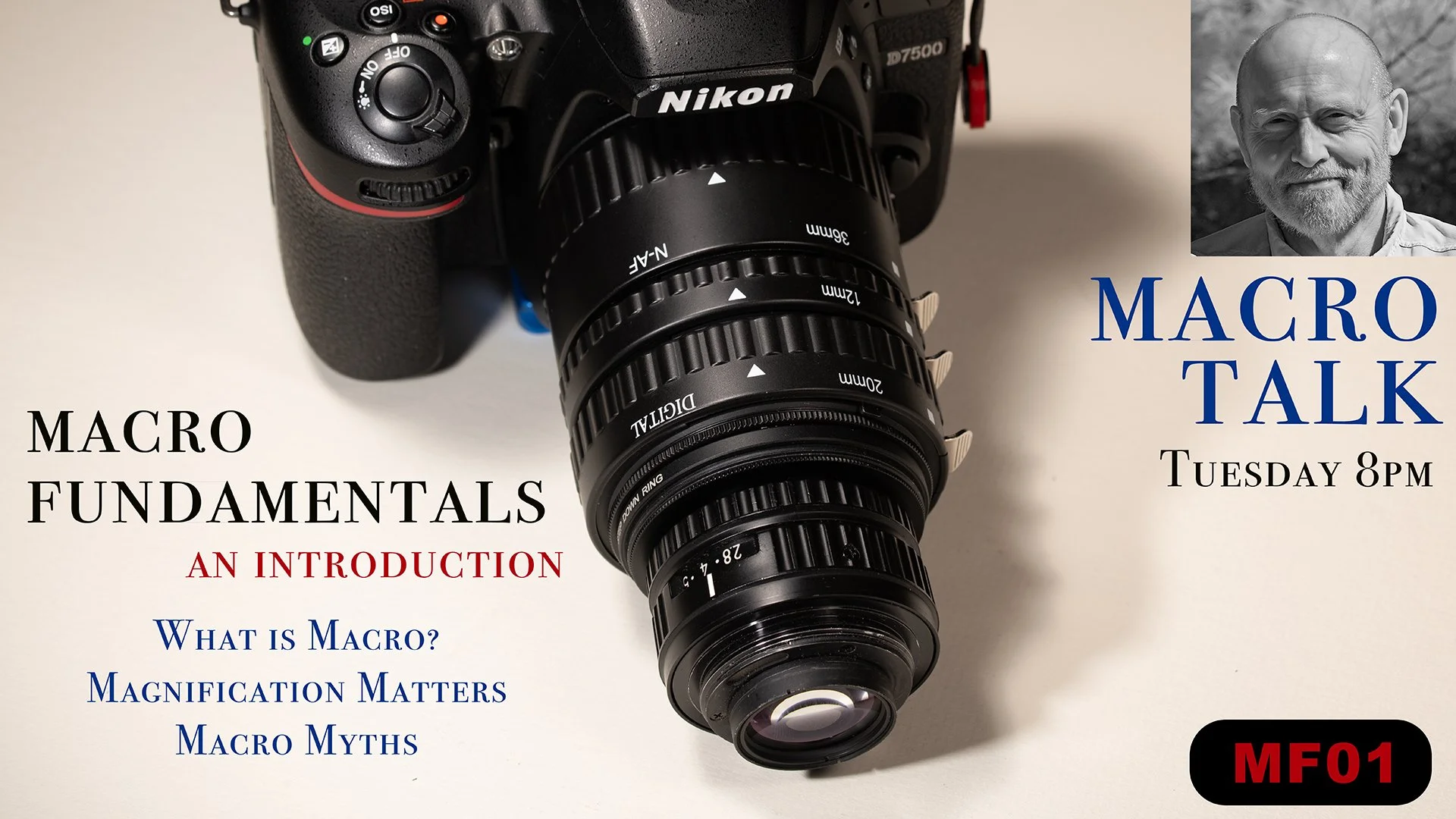
Chapter 1. What Is Macro Photography? (Presented during Macro Talk at 8pm on Tuesday, July 14th, 2026
true macro
close-up vs macro
reproduction ratio
why magnification matters
common myths
Chapter 2. Image Quality (for presentation during Macro Talk Too, at 2pm on Thursday, July 16th, 2026)
sharpness
resolution
contrast
detail
perception
Chapter 3. Understanding Magnification
sensor size
field of view
working distance
perspective
crop factor myths
Chapter 4. Exposure
aperture
shutter
ISO
exposure triangle
ETTR
Chapter 5. Diffraction
Airy disks
aperture limits
practical stopping down
balancing DOF
Chapter 6. Depth of Field
why DOF disappears
magnification effects
diffraction compromise
practical choices
Volume II Optics
Chapter 7. Macro Lens Design
standard macro lenses
enlarger lenses
microscope objectives
process lenses
reversing lenses
Chapter 8. Lens Performance
aberrations
flat field
CA
field curvature
distortion
Chapter 9. Tube Lenses
finite vs infinity
relay optics
focal length choices
telecentricity
Chapter 10. Microscope Objectives
finite
infinity
plan
apo
NA
correction collars
Chapter 11. Resolution Limits
Rayleigh
Abbe
Nyquist
sensor sampling
MTF
Volume III Cameras
Chapter 12. Sensors
pixel size
QE
dynamic range
read noise
full well
Chapter 13. Camera Selection
DSLR
mirrorless
crop
full frame
medium format
Chapter 14. RAW
what RAW actually is
de-bayering
bit depth
myths
Chapter 15. Electronic Shutter
rolling shutter
vibration
flash sync
Volume IV Lighting
Chapter 16. The Nature of Light
reflection
refraction
scattering
polarization
Chapter 17. Diffusion
apparent source size
softness
efficiency
material comparison
Chapter 18. LED Lighting
CRI
TLCI
spectra
flicker
color temperature
Chapter 19. Flash
duration
freezing motion
modifiers
twin flash
Chapter 20. Polarization
crossed polarization
specular reflection
birefringence
practical setups
Volume V. Mechanical Systems
Chapter 21. Stability
vibration
resonance
damping
support systems
Chapter 22. Focus Rails
manual
motorized
calibration
backlash
Chapter 23. Camera Motion
subject motion
camera motion
lighting motion
Chapter 24. Building a Macro Rig
priorities
upgrades
budget
Volume VI. Focus Stackin
Chapter 25. Why We Stack
Chapter 26. Step Size
Chapter 27. Stack Capture
Chapter 28. Zerene
Chapter 29. Helicon
Chapter 30. Artifact Recognition
Volume VII. Subjects
Chapter 31. Insects
Chapter 32. Flowers
Chapter 33. Minerals
Chapter 34. Seeds
Chapter 35. Water
Chapter 36. Everyday Objects
Volume VIII. Image Design
Chapter 37. Composition
Chapter 38. Background Control
Chapter 39. Color
Chapter 40. Visual Storytelling
Volume IX Workflow
Chapter 41. Planning
Chapter 42. Capture Workflow
Chapter 43. File Management
Chapter 44. Post Processing
Chapter 45. Printing
Volume X Mastery
Chapter 46. Diagnosing Problems
Chapter 47. Scientific Thinking
Chapter 48. Equipment Myths
Chapter 49. Building Your Own Equipment
Chapter 50. The Future of Macro Photography
A word on Workflow & Standardization:
This progression/workflow is very similar to what one would encounter in any adult education setting with
each lesson depending naturally on the one before. Coincidently, this workflow also makes AI indexing much more accurate and efficient.
By standardizing the structure of each chapter, when practical, viewers will quickly become accustomed to rhythm of the lesson. I have yet to finalize the structure of each Chapter, the overall layout will answer each of these questions:
1. Definition
What is it?
2. Why it matters
Why should I care?
3. Underlying physics
What’s happening?
4. Practical implications
What changes in the studio?
5. Common mistakes
Where do people go wrong?
6. Summary
The AI Advantage:
This may well prove to be the most valuable feature of this model. Instead of the computer having to search through thousands of content blocks to answer a single prompt, it will be able to focus on one or two Volumes and a small set of Chapters to greatly improve the quality and specificity of the responses being drawn from the rigorously curated and organize
The week ahead:

As noted above, I plan to produce one Chapter of the Macro Fundamentals course each week and I will try to alternate between using the Macro Talk and Macro Talk Too time slots each week and leaving the format for the second Livestream unaltered. This week is an exception to that plan as I would like to take the time to explain the project to the Thursday group, as was done with the Tuesday group. Here is your link for the Thursday stream - https://youtube.com/live/Y2h2rFVTVaI?feature=share

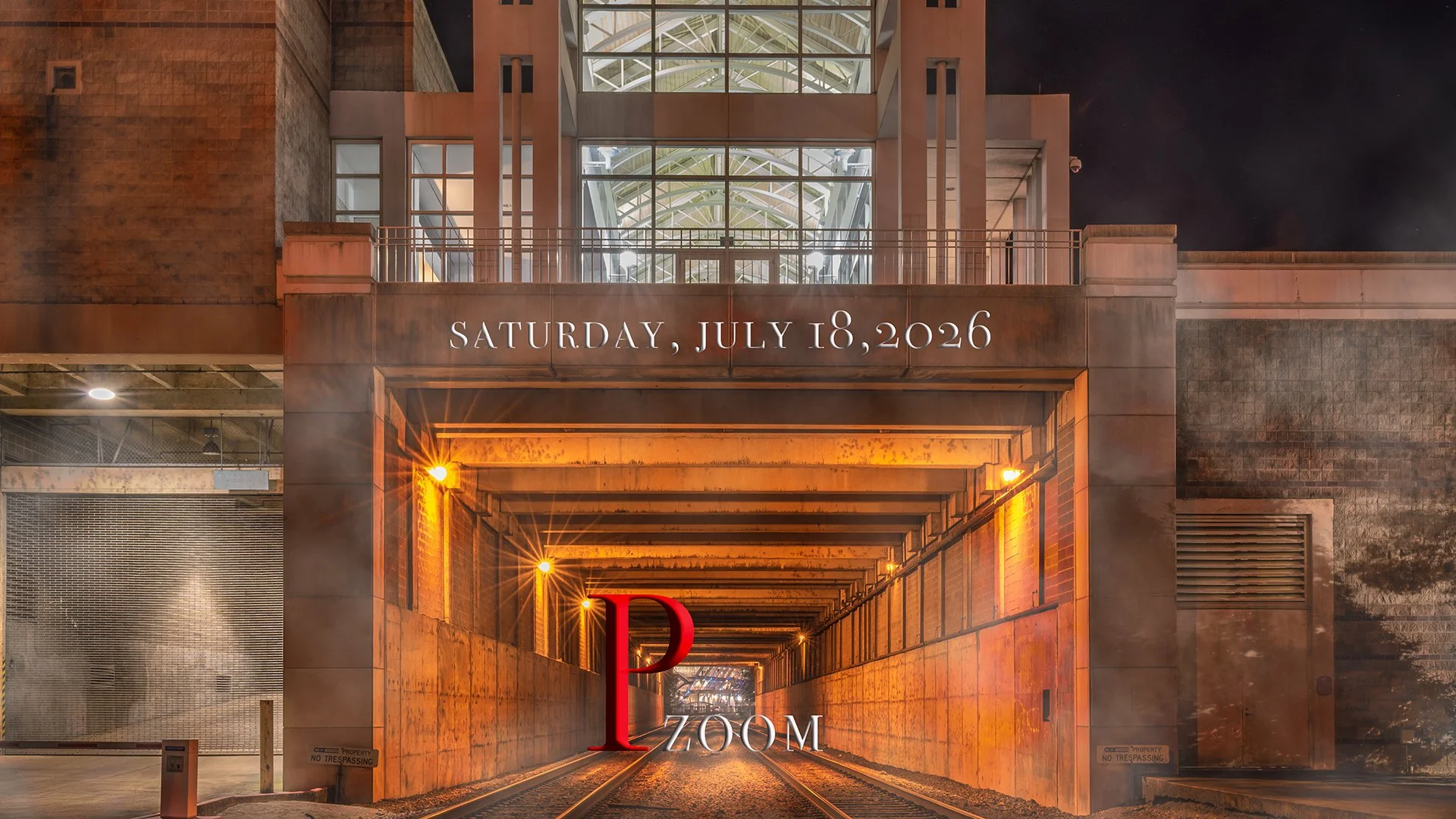
Saturday is a Pzoom day and the format will be as usual with a short segment reserved to look at the Constraint Challenge images for July (change only one parameter), and pick a winner.
Here’s your link to the event -
Allan Walls is inviting you to a scheduled Zoom meeting.
Topic: Allan Walls’ Pzoom Meeting
Time: Jul 18, 2026 10:00 AM Central Time (US and Canada)
Join Zoom Meeting
https://us02web.zoom.us/j/6916802815?pwd=TS9tZi9ZL1NXeVUvOUF4eTg5YjdlZz09&omn=82357173696
Meeting chat link
https://us02web.zoom.us/launch/jc/82357173696
Meeting ID: 691 680 2815
Passcode: 678122
Join by SIP
• 6916802815@zoomcrc.com
Join instructions
https://us02web.zoom.us/meetings/82357173696/invitations?signature=8czZfq7bn7Ecr4_oZ_LLw3rYnXJ3y2-lXTy5cdCVEUA